When a washing machine stops mid-cycle and flashes a code on its display, it can feel like the machine is speaking a language of its own. In reality, those letters and numbers are a built-in diagnostic system, and once you know what a code points to you can often decide whether it is a quick fix or a job for a technician. This guide explains the most common washing-machine error codes by brand, what each family usually indicates, and the sensible first steps to take.
How to read an error code
Most machines display a code as a combination of a letter and a number (for example E18, OE or 4E). The letter often groups the fault by type, and the number narrows it down. A blinking light pattern on machines without a full display works the same way, with the manual providing the key.
The single most important thing to understand is this: a code points to a symptom, not always the exact broken part. A drain error, for instance, can mean a clogged filter, a kinked hose, or a failed pump. So treat the code as a starting point for investigation, not a final diagnosis. Because meanings can vary between models and production years, always cross-check against the manual for your specific model before ordering parts.
Before you do anything else: switch the machine off at the wall and, for any fault involving water or the drum, unplug it. Never reach into a drum that still has water and power connected.
Bosch and Siemens (E and F codes)
Bosch and Siemens share much of their engineering, so their codes overlap. They typically appear as E-codes on older models and F-codes on newer ones.
- E18 / F18 – Drainage problem. The machine could not pump water out in time. Check the drain filter (usually behind a small hatch at the front bottom), the drain hose for kinks, and the standpipe for blockages. In Abu Dhabi’s hard-water conditions, lint and scale build up in the filter faster than many owners expect.
- E23 – Water in the base tray. This indicates a leak has tripped the anti-flood (Aquastop) sensor. Stop using the machine, as continued cycles risk water damage. The leak source needs to be found and fixed.
- F21 – Motor or drive fault. The control board has detected a drum-drive problem, such as a motor or carbon-brush issue. This usually needs a technician.
LG washing machines
LG uses short, readable two-letter codes that describe the fault directly.
- IE – Inlet (water not filling). Check that the taps are open, the inlet hoses are not kinked, and the mesh filters at the valve are not clogged with sediment. Low or interrupted mains pressure can also trigger this.
- OE – Outlet (not draining). Same checks as a Bosch drain fault: filter, hose and pump.
- UE – Unbalanced load. The drum could not distribute the laundry evenly for the spin. Redistribute items, and avoid washing a single heavy item like a rug on its own.
- dE – Door. The door is not latching or the lock is faulty. Make sure nothing is trapped in the seal and the door clicks shut firmly.
- LE – Motor or rotor lock. Often relates to the motor, load overload, or the rotor sensor, and generally needs inspection.
Samsung washing machines
Samsung has used both older codes (like nd) and newer alphanumeric ones, so your display may differ from an older machine’s.
- nd / 5E – Not draining. Water is not leaving the machine. Clean the debris filter and check the drain hose and pump.
- 4E / 4C – Water supply. The machine is not filling correctly. Check taps, hoses and inlet filters, and confirm mains pressure.
- UE – Unbalanced load. Redistribute the laundry as with LG.
- dE / DC – Door. The door is open or not locking. Reseat the door and check for obstructions.
- LE – Leakage. A leak has been detected; stop the cycle and investigate before continuing.
Whirlpool and Indesit (F-series)
These brands generally use F-codes. Meanings vary by model more than most, so the manual matters here.
- F05 – Drainage fault. Typically a drain pump or blockage issue.
- F08 – Heating element fault. Often points to the heater or its wiring. Hard water accelerates limescale on heating elements, which is a common contributor to heating faults in this region.
What you can safely try, and when to call a professional
For drain, inlet and door codes, the owner-level checks above resolve a surprising number of cases. Clean the filter, straighten the hoses, confirm the taps and pressure, and make sure the door seals cleanly. Power the machine off for a minute to clear a one-off glitch, then run a short cycle to see if the code returns.
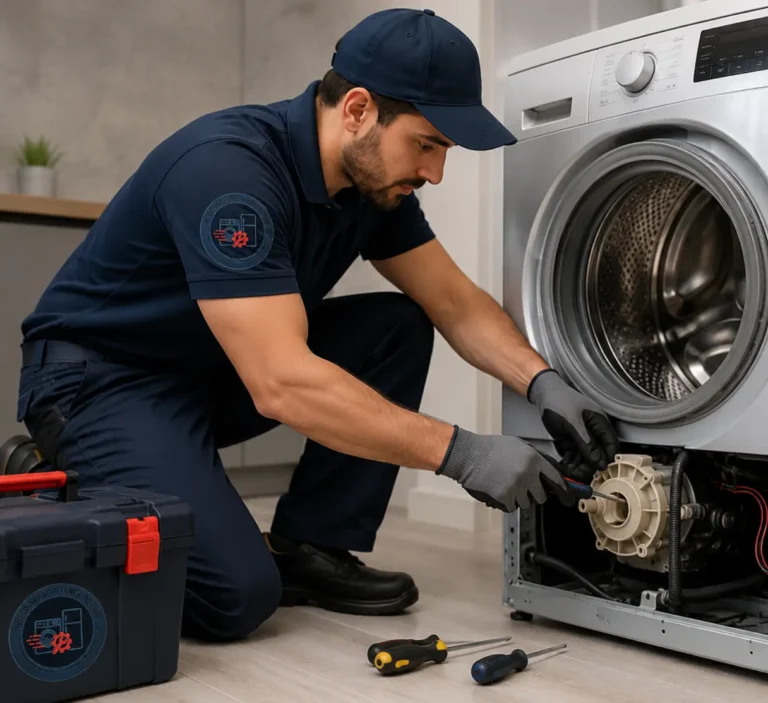
If a code involves the motor, control board, heater, or a detected leak, or if it comes back immediately after you have done the basic checks, it is time for a qualified technician. These faults often involve mains voltage, water under pressure, or dismantling the machine, and guesswork can turn a small repair into an expensive one. A proper diagnosis with genuine or brand-matched parts protects both your machine and your home.
If your washing machine keeps showing an error you cannot clear, our team can diagnose the fault in person and get your machine running safely again. Learn more about our washing machine repair services in Abu Dhabi and book a visit that suits you.